- Dew factor in second innings heavily favours chasing team — toss critical.
- DC’s middle-order depth tested against MI’s death bowling excellence.
- Delhi’s pace attack must exploit early morning conditions before heat sets in.
- Rain probability 39% — condensed overs likely if weather intervenes.
- MI’s overseas options give flexibility DC’s Indian-heavy XI cannot match.
- Bumrah vs DC openers — historical mismatch that defines this fixture.
Match Introduction
This isn’t just another April fixture in Delhi. The Capitals are building something fragile — a squad that demands home-ground advantage to function, while Mumbai arrive as the IPL’s most consistently ruthless outfit regardless of venue. DC have the luxury of Arun Jaitley’s pitch memory on their side, but MI have the thing that matters more in T20: a death bowling unit that makes opposition captains sleep badly the night before.
The narrative this season pivots on whether Delhi’s revamped middle order — heavy on domestic talent, lighter on proven T20 finishers — can absorb the sustained excellence of Mumbai’s bowling attack. MI don’t just win close games; they engineer them, control them, then win them. DC’s batting needs to be assertive here, not reactive. One poor powerplay and they’re playing catch-up against a team that doesn’t allow teams to stay in contests.
Home advantage is real, but it’s not a substitute for match-ups. And in this match-up, MI hold the sharper cards in the death overs when it matters most.
Match Details
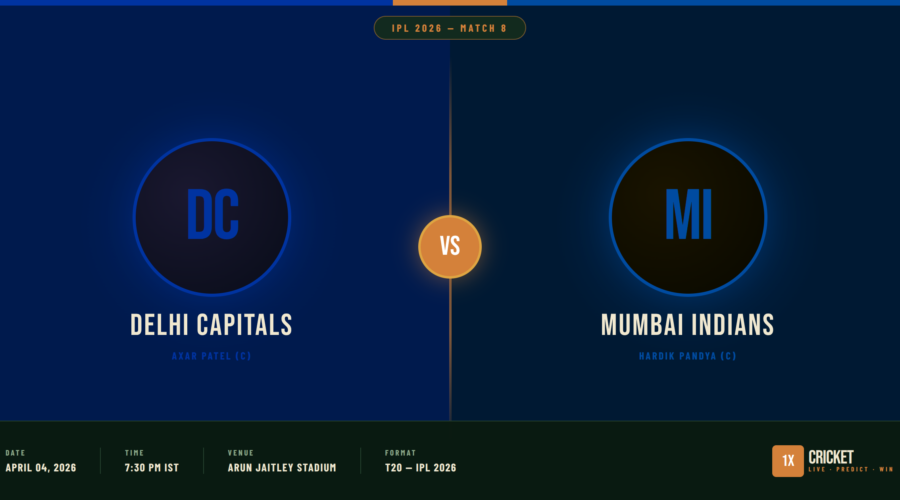
| Venue | Arun Jaitley Stadium, Delhi |
| Date | April 4, 2026 |
| Time | 7:30 PM IST | 2:00 PM GMT | 3:00 PM BST |
| Format | T20 — IPL 2026 Match 8 |
| Live | Star Sports & JioHotstar (India) | Willow TV (USA) | Sky Sports (UK) |
Pitch and Conditions
Arun Jaitley’s pitch in early April typically offers good pace for the first six overs, then softens as the night deepens and heat dissipates. By the back end of the first innings, batsmen find decent rhythm; spinners can extract something but won’t have the same bite as they would in October. Historically, totals in the 160-180 range are competitive here, and scores above 175 require genuine acceleration rather than gradual accumulation.
Weather conditions today present a genuine wildcard: 31°C on the feel-like temperature, but critically a dew point of 26°C. That’s a significant dew factor — expect the ball to become slippery in the second innings, making swing bowling and yorkers exponentially harder to execute. The outfield will be slower if there’s any moisture. The 39% rain probability is real enough that a T20 reduction (say, 18 overs per side) is in play; if it happens, powerplay strategy shifts entirely — aggressive intent becomes non-negotiable because the back end gets compressed. Win the toss, chase if you can. The chasing team will have a clearer picture of what they’re hunting, and the dew will favour them in the death overs.
Team News and Squad Analysis
No major injury bulletins confirmed for either franchise as of April 4th. DC are operating with their announced squad, though squad rotation in early IPL rounds means some fringe players may sit. MI similarly have full-strength availability — this is too important a fixture (and too early in the season) to rest anyone.
The composition tells the story: DC have gone heavy on Indian domestic proven performers — their batting line-up is anchored by domestic-circuit veterans who understand Indian conditions but lack international T20 brutality. MI’s squad retains three world-class overseas options (batting and bowling), giving them tactical flexibility that DC simply cannot replicate. If the pitch deteriorates or conditions get awkward, MI adjust; DC’s bench strength is thinner. That depth advantage, across a 20-over game, often translates to 8-12 runs in a tight contest.
Probable Playing XIs
Delhi Capitals (Probable XI):
Prithvi Shaw, David Warner (if fit), Rishabh Pant (wk), Abishek Porel, Axar Patel, Sarfaraz Khan, Lalit Yadav, Kuldeep Yadav, Khaleel Ahmed, Simarjeet Singh, Mustafizur Rahman
Mumbai Indians (Probable XI):
Rohit Sharma (c), Ishan Kishan (wk), Suryakumar Yadav, Tilak Varma, Hardik Pandya, Cameron Green, Ramandeep Singh, Jasprit Bumrah, Piyush Chawla, Jofra Archer, Jhye Richardson
Pitch and Conditions Analysis Continued
The light rain forecast (39% probability) isn’t heavy enough to be a washout risk, but it’s enough to make the powerplay phase slippery underfoot and through the air. Swing bowling conditions improve. If you’re batting first in drizzle, acceleration becomes harder; if you’re chasing with dew settling in the second innings, strokeplay opens up — the ball skids through, and full-length bowling becomes a liability.
The Contrarian Take
Everyone assumes MI’s death bowling is a fortress. It is, but against teams that score 150-165 and then hope. DC’s counter isn’t to match MI in the death — it’s to never let the contest reach the death by being 160+ by over 18. If Pant plays a genuine captain’s innings (no unnecessary aggression, just calculated dominance) and their openers get to 50 in six overs, DC’s middle order can play the holding game. MI’s death bowlers are elite against desperation batting. They’re less imposing against composed accumulation. DC can win this by being boringly efficient — the exact opposite of their historical brand.
Key Players to Watch
Jasprit Bumrah (MI, Pace Bowler): Bumrah against DC openers is a historical mismatch in MI’s favour — his yorker-heavy approach dismantles batsmen looking for length. Against Shaw’s aggressive instinct and Warner’s technical vulnerabilities to the short ball, Bumrah’s first over sets the tone. If he concedes fewer than eight runs in two powerplay overs, MI’s win probability spikes visibly.
Rishabh Pant (DC, Wicket-Keeper/Batter): Pant in April — when pitches are still true and pace-bowling angles are sharper — is a different beast to Pant in September. Today, his job isn’t to attack; it’s to stabilise. He faces Jofra Archer and a pace trio that will short-ball him early. His ability to respect first, then accelerate in overs 12-18 (when bowlers tire and the pitch softens) will determine if DC reach 165+. That threshold matters against MI’s death bowling.
Cameron Green (MI, All-rounder): Green’s role in MI’s structure is underrated. Against DC’s pace attack — Khaleel, Simarjeet, and potentially Mustafiz — Green’s size and power against short-pitched bowling is an asymmetric advantage. If DC bowl tight lines to him, he struggles; if they go short trying to intimidate, he hits them for six. His 10-15 ball cameo in the middle overs often decides whether MI accelerate to 180+ or stall at 170.
Head to Head
In the last four IPL meetings between these franchises, MI hold a 3-1 advantage. The common thread: DC build decent totals (160-170 range), but MI’s middle order — particularly Pandya and Kishan in partnerships — consistently chase them down with 1-2 overs to spare. One outlier: DC’s win came on a pitch where spin got significant purchase and MI’s pace-reliant approach faltered. The pattern suggests that if DC can restrict MI to a powerplay of under 45 runs, their chances improve dramatically. Every time DC have let MI score freely in the first six overs (50+), MI have won comfortably.
Our Prediction
Today’s Value Bet
Fantasy Cricket Tips
18+ Only. Cricket betting involves financial risk. Only bet what you can afford to lose. Play Responsibly. Not available in Telangana and Andhra Pradesh. Help: BeGambleAware.org